What Is Query-Passage Alignment? The Core Metric of Answer Engines
TL;DR / Executive Summary
- Query-Passage Alignment measures how directly a single passage of web text satisfies the intent of a user prompt without introductory noise or missing entity relationships.
- Unlike keyword density (which measures string frequency), alignment evaluates sentence-level term co-occurrence, heading intent matches, and passage word concentration.
- AEO Impact: In modern RAG pipelines, content with high alignment scores is prioritized by Cross-Encoders and selected for live LLM citations, while unaligned content is dropped.
Moving Beyond Keyword Density to Intent Alignment
In classic SEO, digital marketers analyzed keyword density—calculating what percentage of a page contained specific strings like "best enterprise accounting software".
In Answer Engine Optimization (AEO), LLMs like ChatGPT, Claude, and Perplexity do not count word occurrences. Instead, they measure Query-Passage Alignment (a foundational neural retrieval concept evaluated on benchmarks like Microsoft's MS MARCO Dataset).
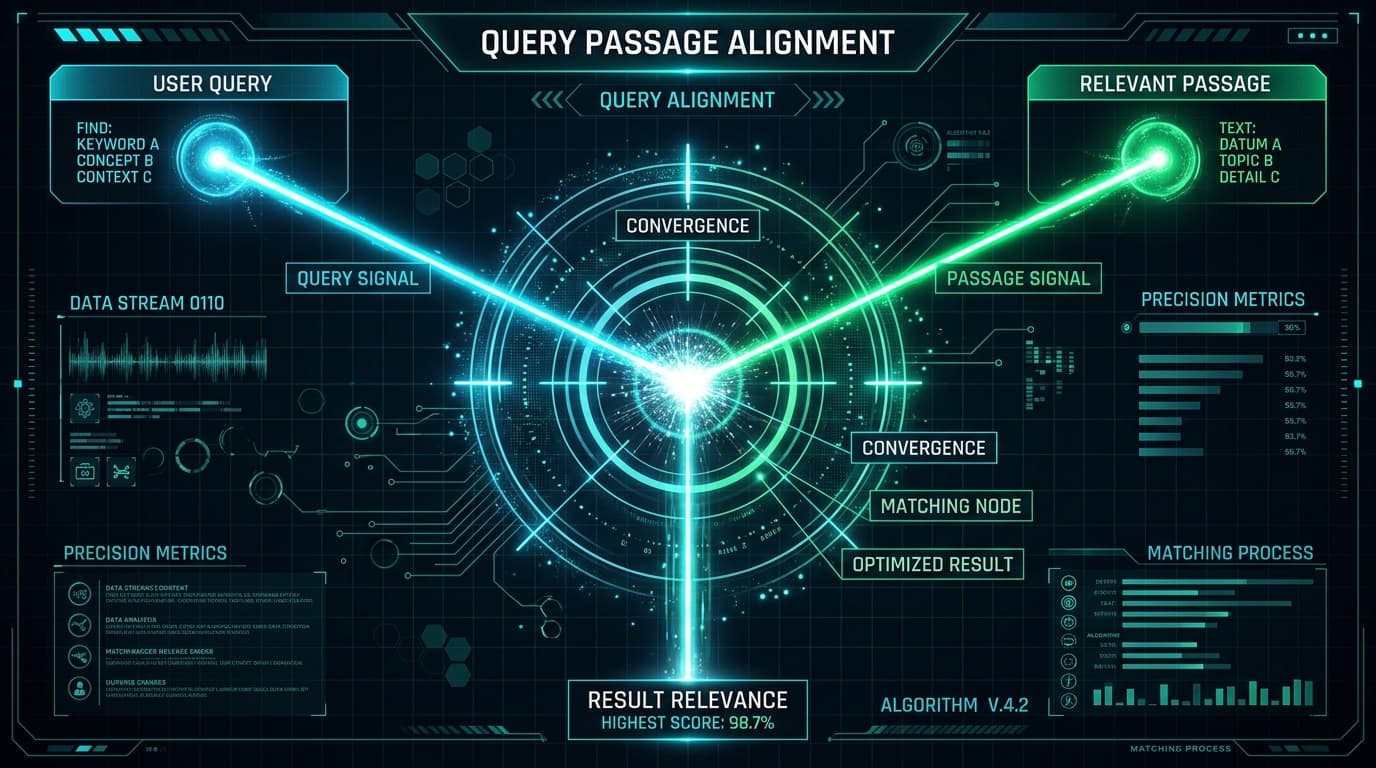
Query-Passage Alignment evaluates whether a standalone paragraph contains both the intent of the prompt and the complete resolution to that prompt in close typographic proximity.
The 3 Pillars of High Query-Passage Alignment
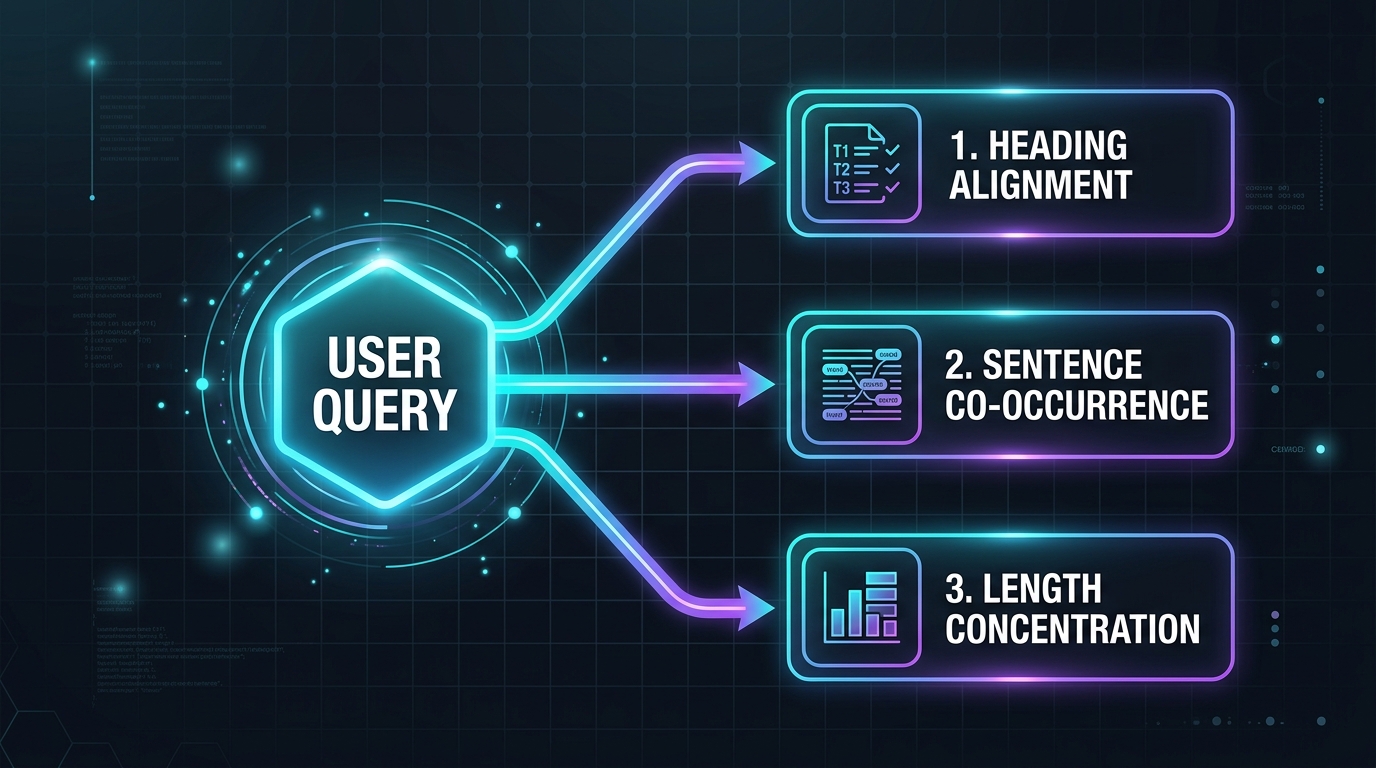
When neural retrievers process candidate passages, they evaluate three specific structural properties:
1. Heading-to-Body Intent Match
If your <h2> heading asks "How does cosine similarity work in vector search?", the passage directly underneath must address cosine similarity within the first 15–20 words. If the paragraph instead discusses the history of linear algebra, the heading-to-body alignment breaks.
2. Single-Sentence Term Co-occurrence
Cross-Encoders reward passages where core query entities occur within the exact same sentence.
- Low Alignment: Entity A is in sentence 1, and Entity B is mentioned 4 sentences later.
- High Alignment: Entity A directly interacts with Entity B by calculating high-dimensional vector angles.
3. Word Length Concentration (The Density Window)
Retrieval models penalize both ultra-short snippets (under 40 words) and overly verbose text blocks (over 400 words). The ideal concentration window for high query-passage alignment is 60 to 280 words.
Code Logic: How Alignment Scores Are Calculated
To understand how modern AEO systems score alignment, examine how joint term co-occurrence and heading boosts are calculated programmatically:
def calculate_passage_alignment(query: str, heading: str, passage: str) -> dict:
    # Evaluates Query-Passage Alignment based on term co-occurrence and density. #
    q_tokens = set(q.lower() for q in query.split() if len(q) > 2)
    heading_lower = heading.lower()
    passage_lower = passage.lower()

    # 1. Heading Intent Alignment (0 - 100%)
    heading_matches = sum(1 for token in q_tokens if token in heading_lower)
    heading_alignment = (heading_matches / len(q_tokens)) * 100 if q_tokens else 0

    # 2. Sentence-Level Co-occurrence Peak
    sentences = [s.strip() for s in passage_lower.split('.') if s.strip()]
    max_co_occurrence = 0
    for sentence in sentences:
        matches = sum(1 for token in q_tokens if token in sentence)
        if matches > max_co_occurrence:
            max_co_occurrence = matches

    co_occurrence_score = (max_co_occurrence / len(q_tokens)) * 100 if q_tokens else 0

    # 3. Density Penalty / Reward
    word_count = len(passage.split())
    density_status = "Optimal"
    if word_count < 50:
        density_status = "Too Short (Lacks Context)"
    elif word_count > 350:
        density_status = "Too Verbose (Fluff Penalty)"

    return {
        "heading_alignment_score": round(heading_alignment, 1),
        "co_occurrence_score": round(co_occurrence_score, 1),
        "word_count": word_count,
        "density_status": density_status
    }
Before & After: Rewriting Content for Query-Passage Alignment
❌ Low Alignment Example (Classic SEO Fluff)
Heading: What is Dense Vector Search?
Passage: In today's rapidly evolving digital ecosystem, data management has become paramount for enterprise organizations. As businesses collect millions of records, traditional databases often struggle to scale efficiently. Many technology leaders are now turning to modern artificial intelligence tools. Search technology has come a long way since the early 1990s...
Why it fails: The passage contains 50+ words of preamble fluff. The core query terms ("dense vector search") do not co-occur in any single sentence, and the answer is delayed.
✅ High Alignment Example (AEO Optimized)
Heading: What is Dense Vector Search?
Passage: Dense vector search is an AI retrieval method that converts unstructured text into high-dimensional numerical vectors to locate semantically similar content. Unlike traditional keyword matching, dense vector search measures the mathematical angle between query and passage embeddings using cosine similarity, allowing search engines to understand contextual intent regardless of exact word overlap.
Why it succeeds: The answer is delivered in sentence 1. Query entities ("dense vector search", "numerical vectors", "cosine similarity") co-occur in tight proximity within an optimal 65-word paragraph block.
AEO Optimization Checklist for Content Writers
- Answer First: State the direct answer in the very first sentence under each <h2> or <h3> tag.
- Tight Sentence Co-occurrence: Ensure the primary subject, action, and outcome reside in the same sentence.
- Target Paragraph Length: Keep standalone passage blocks between 60 and 280 words.
- Eliminate Introductory Preamble: Remove phrases like "In today's digital landscape..." or "It is important to remember that...".
Measure Your Content's Alignment Score
Does your web content achieve high alignment scores across modern RAG pipelines?
How Our AEO Scanner Benchmarks Alignment:
Our AEO Scanner evaluates your page's heading-to-body intent alignment, sentence term co-occurrence density, and word length concentration, pinpointing exact paragraphs that fail alignment checks.
NEXT STEPS
Need to Outpace the Competition in AI Search?
Whether you need an AEO audit, content re-engineering, or custom AI strategy — let's build what's next.